
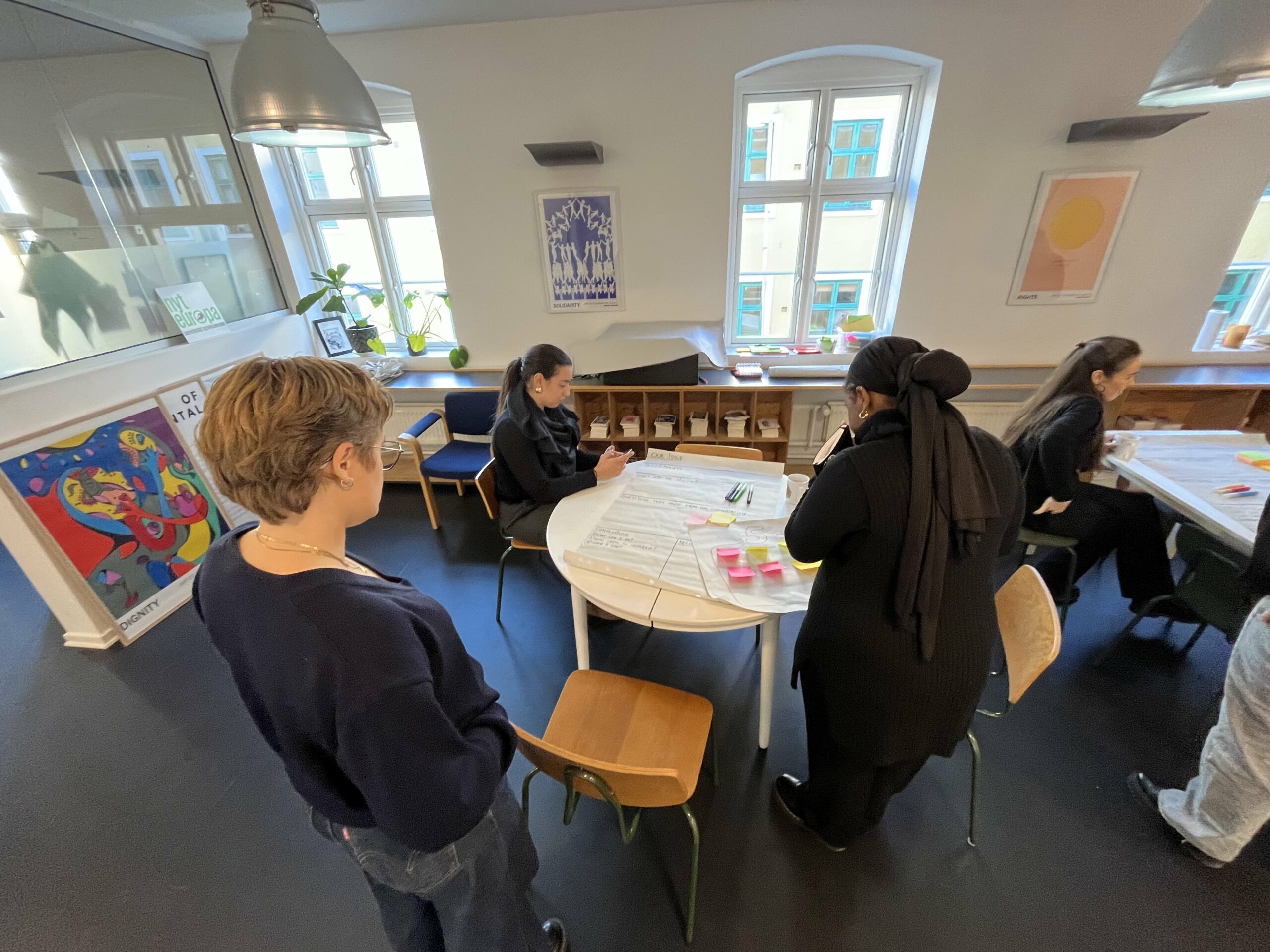
The Transnational Citizens’ Panel hosted by Nyt Europe in Copenhagen, Denmark, on the 19th-21st of November, 2025, brought together professionals, civil society actors, and citizens from Europe to discuss both how democratic challenges play out across Europe, how citizens face these while participating in mitigating climate change issues.
The discussions centered around two main topics: 1) citizens’ participation, and 2) involvement in climate change mitigation. Following the speakers’ presentations and participatory group work, these topics resulted in four “main issues” within that sphere. The collaborative work carried out over these two days resulted in the following recommendations on these four issues and on how the EU should enhance inclusive participation, especially regarding climate issues and the greening of Europe.
Recommendations
PARTICIPATION & DEMOCRATISATION
Main issue(s): limited tools; lack of implementation; lack of democratic resilience; social polarization; lack of transparency
- Educate and create awareness in schools, via youth summits (a common European initiative), etc.
- Need to consider different contexts when formulating resolutions and strategies
- Make funding more accessible for smaller NGOs/communities/citizens to increase participation (as opposed to big lobby organizations)
- Have “EU ambassadors”, a link to the institution(s)
- Lowering the threshold on the European Citizens’ Initiative and various national mechanisms that allow the population to create change
- Paid leave for citizens to attend assemblies and similar events: create incentives for people to participate and make participation accessible
- Facilitate “green Bildung”, i.e. educate and engage citizens in ecological democracy
- Equip local initiatives with the mechanisms, tools, and knowledge to convey their ideas to decision-makers (funding and know-how)
SECURITY & CLIMATE
Main issue(s): military security vis-à-vis climate security; how to mitigate a disconnected, individualistic approach; how to prioritize climate in EU budget together with increased military spending; feeling of disempowerment in society à lack of involvement
- Integrate sustainability into defense and security strategies. Don’t keep them as separate entities, e.g., phasing out fossil fuels in the military industry
- NGOs should act more as communities than organizations to make it easier for people to engage in a relaxed manner. Organizations can sometimes become silos and inaccessible to citizens without connections to such organizations
- Reorganize climate and security strategies into achievable steps, so that citizens experience concrete change
- Homogenous implementation of climate and security policies to incentivize participation and make it easier to do so
- More transparency in collaboration between NGOs and the EU
- Climate resilience must become a topic theme through: i) more public discussions, ii) European decision-makers, iii) social media platforms
- Increase the role of EU institutions in green participation
- Align climate and military approaches in Member States
- Promote the concept that environmental issues are also security issues: How are European citizens affected by climate change, e.g., flooding, heatwaves, burned crops, etc.
- Community involvement/organization, as opposed to “professional” organizations, is the key to policy implementation
SUSTAINABILITY & COMPETITIVENESS
Main issue(s): deregulation versus corporate accountability; do we need to compete on all levels globally? Progress versus longevity; how to sustainably innovate versus fast innovation
- Become better at explaining why rules are imposed/suggested: responsibilities, accountability
- Simplify language, not just regulations, regarding legislation, and explain the benefits for everyday life, making it concrete
- Engage with local representatives, influencers to help explain
- The long-term benefits of legislation must be visualized/explained/exemplified
- Challenge the narrative that sustainability and competitiveness are mutually exclusive – include different perspectives in the conversations, contextualize
- Making eco-friendly alternatives more accessible to the general public: subsidies, regulating prices, etc.
- Collect data on greenwashing and make these accessible to the public
- Cohesive, understandable regulation for cooperation’s accountability: oversight of supply chain, manufacturing, etc.
JUST TRANSITION
Main issue(s): justice for whom? structural and institutional challenges and barriers for a just transition.
- Create “Declaration of Climate Rights” in the vein of the Declaration of Human Rights: security for non-human entities, a future law to secure the ocean, animals, nature, biodiversity, etc.
- Increase youth participation and intersectional perspectives
- Indigenous inclusion in policy frameworks
- Explore possibilities in the implementation of a well-being economy
The EU for Global project is funded by the European Union. Views and opinions expressed are however those of the author(s) only and do not necessarily reflect those of the European Union or CERV. Neither the European Union nor the granting authority can be held responsible for them.